
What if the moment our technicians step out of your door isn’t the end of a service, but the beginning of your home’s most refined chapter? Many homeowners view a professional visit as a temporary reset, often living in fear that a single spill or a busy afternoon will ruin the pristine results. It’s common to feel frustrated when carpets seem to re-soil quickly or when conflicting advice leaves you uncertain about the best way to protect your investment. Understanding how to maintain a clean carpet after professional service is not about constant labor, but about adopting a sophisticated rhythm of stewardship that honors your private environment.
We’ve curated the essential professional secrets to help you preserve that signature finish and extend the life of your carpet’s delicate fibres. You’ll discover how to manage the nuances of daily care while maintaining the peace of mind that comes with a truly hygienic home. This guide provides a clear path from the initial transformation to a long-term state of order, ensuring your environment remains as fresh and inviting as the hour we finished our work.
Key Takeaways
- Establish a foundation for success by managing airflow and preserving furniture placements during the vital first twenty-four hours of drying.
- Adopt the “Slow Pass” vacuuming technique to understand how to maintain a clean carpet after professional service by prioritizing depth over speed.
- Protect fibre integrity by mastering professional spill management, avoiding harsh retail chemicals that often lead to rapid re-soiling.
- Implement strategic environmental barriers, such as the dual-mat system, to prevent external contaminants from entering your private sanctuary.
- Determine your bespoke maintenance schedule and the role of fabric protection in providing a lasting shield for your home’s most delicate textiles.
The Critical First 24 Hours: Post-Service Care
The transition from a professional technician’s presence to your personal stewardship is the most delicate phase of the restoration process. While the fibres may look and smell revitalized, the internal structure of the textile remains in a state of adjustment. Understanding how to maintain a clean carpet after professional service begins with respecting this initial twenty-four-hour window. During this time, the carpet is settling into its clean state, and your primary role is to ensure the environment supports a swift, uniform return to a dry equilibrium.
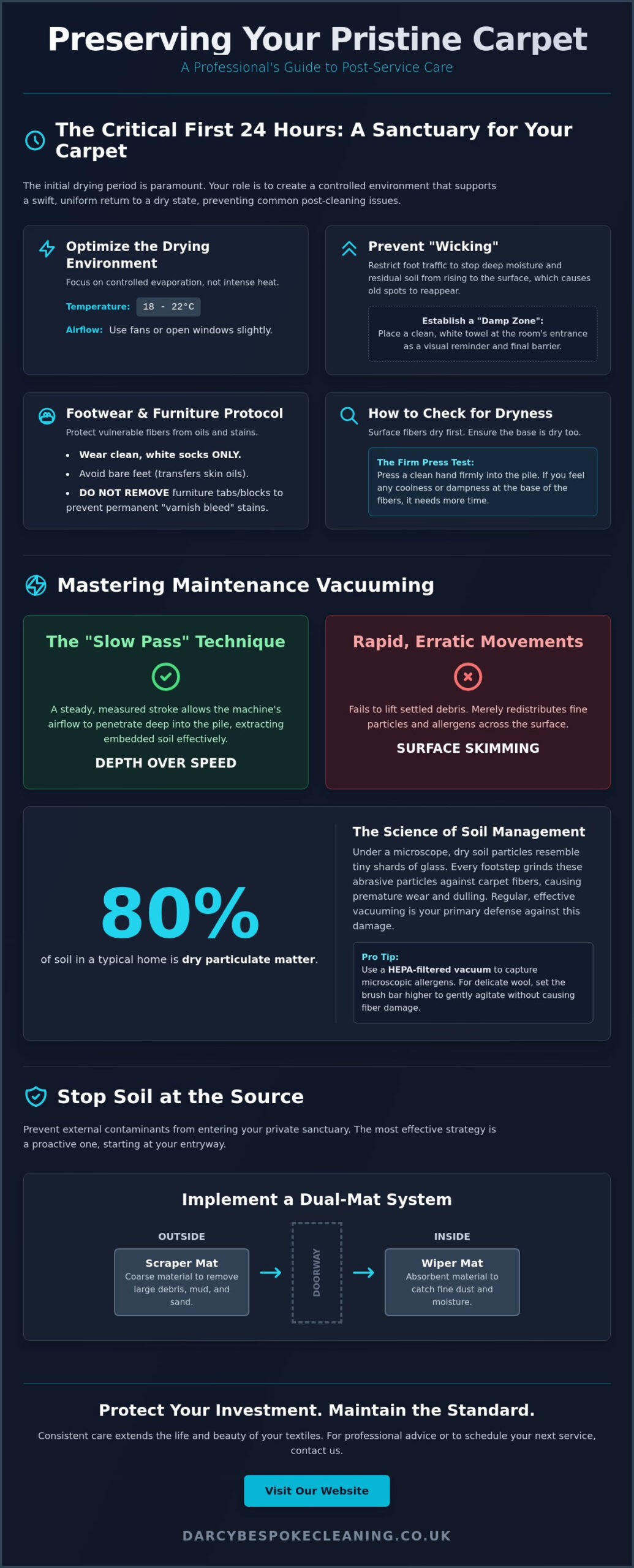
One of the most significant risks during this period is a phenomenon known as wicking. When moisture remains deep within the backing, premature foot traffic can create a capillary effect, pulling dampness and any residual deep-seated soil to the surface tips. This often results in the reappearance of old spots that seemed to have vanished. By restricting access and managing the atmosphere, you prevent this upward migration of moisture. Different carpet cleaning methods require varying recovery times, but a standard rule of thumb is to treat the area as a sanctuary for at least one full day.
To avoid accidental soil transfer, we recommend establishing a “damp zone” protocol. This involves placing a clean, white towel at the entry point of any treated room. This serves as a physical reminder for family members and provides a final barrier to catch any oils or dust from footwear before they touch the vulnerable, damp fibres.
Optimising the Drying Environment
The key to a pristine finish is controlled evaporation. We suggest setting your thermostat to a steady, gentle warmth, ideally between 18 and 22 degrees Celsius. Avoid the temptation to overheat the room, as excessive heat can sometimes cause natural fibres to become brittle or shrink. Instead, focus on airflow. In Fife, where coastal humidity can often linger, using oscillating fans or keeping windows slightly ajar can drastically reduce drying times by moving saturated air away from the floor surface. This steady circulation is the most effective way to ensure the base of the carpet dries as quickly as the surface.
Footwear and Furniture Precautions
While the carpet is drying, clean white socks are the only acceptable footwear. Bare feet can transfer natural skin oils, and slippers often have soles that carry invisible residues from other parts of the home. Perhaps most importantly, you must leave all furniture tabs and blocks exactly where our technicians placed them. These small barriers are vital; they prevent “varnish bleed,” where the moisture in the carpet reacts with the dyes or finishes on wooden furniture legs, causing permanent stains. To verify if your carpet is truly dry, don’t just feel the soft tips. Press a clean hand firmly into the pile to check for any coolness or dampness at the very base of the fibres.
Mastering the Art of Maintenance Vacuuming
Once the initial drying phase concludes, the focus shifts to a deliberate rhythm of upkeep. Vacuuming is often dismissed as a mundane chore, yet it is the most critical element in determining how to maintain a clean carpet after professional service over the long term. The secret lies in the “Slow Pass” technique. Rapid, erratic movements fail to provide the necessary time for the vacuum’s airflow to penetrate the pile and lift settled debris. Instead, a steady, measured stroke allows the machine to perform its intended function, ensuring that soil is extracted rather than merely redistributed.
For homes in Fife, where external elements like coastal sand or garden soil are frequently introduced, a HEPA-filtered vacuum is essential. These systems ensure that microscopic allergens and fine dust are captured rather than exhausted back into your living space, preserving the refined air quality of your home. If your flooring features delicate wool fibres, pay close attention to the brush bar height. Setting the beater bar too low can cause mechanical abrasion, leading to premature fuzzing and loss of texture. A higher setting that gently agitates the surface is often sufficient for maintaining proper carpet care without compromising the textile’s integrity.
The Science of Soil Management
Dry soil is surprisingly abrasive. Under a microscope, these particles resemble tiny shards of glass that saw away at carpet fibres with every footstep. Industry data suggests that approximately 80% of the soil in a typical home consists of dry particulate matter. This is a significant finding for the diligent homeowner, as it means the vast majority of potential damage can be prevented through mechanical extraction. Focus your efforts on “traffic lanes,” the invisible paths where people walk most frequently. Using multi-directional strokes in these areas ensures that you lift the pile and access soil trapped on all sides of the fibre.
Equipment Stewardship
A vacuum is a precision tool that requires its own level of guardianship. Suction power diminishes significantly as bags fill or filters become clogged, rendering your efforts less effective. We recommend replacing bags when they are two-thirds full and inspecting filters monthly. For those with luxury rugs or deep-pile carpets, the choice between a beater-bar and a suction-only vacuum is vital. While beater-bars are excellent for synthetic piles, suction-only attachments are often safer for hand-tufted or delicate natural materials. If you are unsure which method suits your specific flooring, our team can provide a bespoke maintenance assessment during your next visit.
Managing Spills with Professional Precision
Accidents are an inevitable part of a well-loved home, but they don’t have to be a source of lasting anxiety. True stewardship involves reacting with calm precision rather than frantic scrubbing. The cardinal rule of fibre preservation is the “Blot, Don’t Rub” commandment. Rubbing a spill creates mechanical friction that can permanently distort the delicate twist of the carpet pile, leading to a “fuzzy” or frayed patch that remains visible even after the pigment is gone. By learning how to maintain a clean carpet after professional service through gentle extraction rather than force, you protect the structural integrity and aesthetic harmony of your flooring.
Many homeowners reach for supermarket “spot cleaners” as a first resort, unaware of the hidden chemical consequences. These retail products often contain high concentrations of surfactants and detergents designed to break down oils aggressively. However, without professional-grade extraction equipment, these soapy residues remain trapped deep within the fibres. They act as a microscopic adhesive, attracting household dust and Fife mud with alarming speed. This leads to the “resoiling trap,” where the area looks clean for a few days before a dark, sticky patch emerges that is far more difficult to treat than the original spill.
The Blotting Protocol
To manage a liquid spill effectively, reach for a clean, white cotton towel. The lack of dye in the towel is crucial; it ensures you don’t accidentally transfer new pigment into the damp carpet. Use the following steps for a refined response:
- Place the towel over the spill and apply firm, downward pressure with the heel of your hand.
- Work meticulously from the outside edges toward the centre of the spill.
- This outside-in approach prevents the liquid from spreading horizontally and forming a permanent “ring” mark.
- Continue the process, rotating to a fresh, dry section of the towel, until no more colour transfers from the carpet.
Avoiding the Resoiling Trap
If the spill persists after blotting, plain lukewarm water is often your most reliable ally. It helps dilute the substance without introducing complex chemical residues that might bleach the fibres or alter their pH balance. Be particularly wary of oxygen-based cleaners or “miracle” foams, which can “set” certain stains like coffee or red wine, making them impossible to remove later. If a spill proves stubborn, it’s wiser to pause and consult a professional Stain Removal Treatment. Attempting to force a result with household chemicals often turns a temporary accident into a permanent blemish on your environment.
Environmental Barriers: Stopping Soil at the Source
The most effective way to preserve a professional finish is to ensure that external contaminants never cross your threshold. True stewardship requires a proactive defense. A sophisticated “Dual Mat” system is your first line of protection. This involves a high-quality coarse scraper mat positioned outside the entrance to dislodge heavy debris, followed immediately by an absorbent interior mat to capture fine dust and moisture. This two-stage barrier is essential for anyone learning how to maintain a clean carpet after professional service, as it significantly reduces the volume of particulate matter that reaches your living areas.
In Fife, our environment presents unique challenges. The damp autumn mud and the corrosive salt used on winter roads can be particularly damaging to delicate fibres if tracked indoors. Salt, in particular, is hygroscopic, meaning it attracts moisture from the air and can leave your carpet feeling perpetually damp or “sticky.” By implementing a strict matting protocol, you act as a guardian of your home’s interior climate. We also suggest a refined “No-Shoes” policy. Providing elegant indoor footwear for guests is a subtle way to maintain hygiene without compromising the hospitality of your home.
Strategic Mat Placement
For a mat to be effective, it must follow the “Three-Step Rule.” This ensures that each foot makes contact with the matting at least three times before stepping onto the carpet. A small, decorative mat often fails this test. While aesthetics are important in high-end Fife interiors, functionality must lead. Remember that a saturated or dirty mat ceases to be a barrier and instead becomes a source of soil. Regularly cleaning these entry points is vital. If your environment includes pets, a dedicated station for cleaning paws at the door will prevent the transfer of natural oils and outdoor odours into your freshly cleaned textiles.
Air Quality and Dust Control
Soil doesn’t only arrive on the soles of shoes. It also settles from the air. Maintaining your home’s HVAC system is a subtle yet powerful component of how to maintain a clean carpet after professional service, as it addresses the soil that arrives from the air. Changing filters regularly prevents the accumulation of the “grey film” often seen at the edges of carpets, known as filtration soiling. This occurs when air is forced through the carpet at the baseboards, leaving behind fine carbon and dust particles. Managing indoor humidity is equally important. High humidity creates a “sticky” fibre state that causes airborne dust to bond more readily to the pile. For comprehensive protection against these invisible threats, we recommend our professional fabric protection service to create an invisible shield against both liquid and particulate soil.
Long-Term Preservation and the Darcy Standard
The culmination of your stewardship journey lies in the transition from reactive care to a proactive partnership. While your daily efforts are the heartbeat of preservation, the Darcy Standard provides the framework for long-term excellence. Mastery of how to maintain a clean carpet after professional service involves more than just immediate reactions; it requires a strategic vision for your home’s textiles. By treating your flooring as a curated asset rather than a utility, you ensure its beauty remains untarnished by the passage of time and the rigours of daily life. This commitment to quality is what separates a mere house from a refined sanctuary.
Our role as custodians of your environment extends beyond the physical task of cleaning. We view our service as a lifestyle enhancement that brings a sense of order and harmony to your private spaces. This is why we advocate for a structured approach to maintenance, where professional expertise and personal stewardship work in tandem. When you understand how to maintain a clean carpet after professional service, you aren’t just cleaning; you’re preserving a standard of living that values both hygiene and aesthetics. Our 100% satisfaction guarantee serves as your ultimate safety net, providing the peace of mind that your home is in the hands of dedicated experts.
The Value of Fabric Protection
Professional fabric protection acts as an invisible shield, providing a critical layer of defense for high-value rugs and carpets. This treatment works by creating surface tension at the molecular level, allowing liquid spills to bead on the surface rather than soaking into the core of the fibre. This buys you vital seconds to execute the blotting protocol discussed earlier. Beyond spill resistance, these protectors also reduce the impact of sun-fading and mechanical abrasion by coating the fibres in a microscopic, lubricating barrier. Because deep steam cleaning can gradually strip away these protective layers, we recommend re-applying the treatment after every significant service to maintain the integrity of the barrier.
Planning Your Next Professional Visit
Determining the ideal frequency for your professional visits is a bespoke process. There is no universal rule; instead, we look at the unique rhythm of your household. For homes with active pets or young children, a six-month interval is often the most effective way to manage biological soil and allergens. In more tranquil environments or guest suites, a twelve to eighteen-month cycle may suffice. High-traffic commercial spaces or homes that frequently host social gatherings often benefit from “interim” cleaning, which focuses on high-visibility areas to prevent soil build-up from becoming permanent. To secure your home’s future aesthetic, you can Book your next bespoke maintenance visit with Darcy Bespoke Cleaning today. By choosing a path of dedicated stewardship, you protect the comfort and health of your family for years to come.
Cultivating a Lasting Legacy of Cleanliness
Maintaining the elegance of your home is a continuous journey of stewardship that begins the moment we leave. By respecting the initial drying window and adopting the “slow pass” vacuuming technique, you ensure the deep-seated integrity of your textiles remains uncompromised. You now possess the professional secrets to managing spills with precision and creating environmental barriers that keep the coastal elements of Fife at bay. Truly understanding how to maintain a clean carpet after professional service transforms a standard task into a lasting commitment to excellence.
As family-run independent specialists in Fife, we combine our 100% Satisfaction Guarantee with advanced Alltec and Rotovac technology to deliver results that transcend the ordinary. We invite you to view our work as the foundation of your home’s hygiene and refined comfort. Experience the Darcy Bespoke difference; Book your professional deep clean today and allow us to help you become the ultimate custodian of your environment. Your home deserves a level of care that reflects its true value, and we are here to support that vision at every step.
Frequently Asked Questions
How long should I wait to walk on my carpet after a professional clean?
You should wait at least six to twelve hours before walking on your carpet with clean socks, though twenty-four hours is the ideal window for full recovery. Walking on damp fibres too soon can cause wicking or flatten the pile before it has properly set. If you must enter the room, ensure your footwear is perfectly clean to avoid transferring oils. This patience is a vital part of how to maintain a clean carpet after professional service.
Can I use a hairdryer to speed up the carpet drying process?
We don’t recommend using a hairdryer as concentrated heat can cause certain fibres, particularly wool or delicate synthetics, to shrink or become brittle. Instead, focus on natural airflow by opening windows or using oscillating fans. A steady, gentle movement of air is far more effective at lifting moisture without risking the structural integrity of your textile. This approach preserves the soft texture we’ve worked to restore.
Why does my carpet feel slightly stiff after it dries?
A slight stiffness is often a sign that the fibres have dried in a fixed position, a common occurrence with high-quality natural materials. This isn’t a sign of residue but rather the “set” of the pile. Once the carpet is completely dry, a gentle, slow-pass vacuuming will break this temporary bond. This simple action returns the luxurious, soft feel to the surface while maintaining the harmony of your home’s interior.
Is it normal for some stains to reappear a few days after cleaning?
It’s possible for deep-seated stains to reappear through a process called wicking, where moisture pulls old soil from the backing to the surface. This typically happens if the drying process is slowed by high humidity or restricted airflow. If you notice a spot returning, don’t attempt to scrub it. Contact us for a professional assessment, as we can often resolve these occurrences with specialized low-moisture techniques that prevent further migration.
Do I really need to vacuum my carpet if it still looks clean?
Regular vacuuming is essential because the most damaging soil is often invisible to the naked eye. Shards of dry particulate matter settle deep within the pile, acting like tiny blades that saw away at the fibres with every step. By maintaining a consistent schedule, you prevent this mechanical wear before it becomes visible. This proactive rhythm is the cornerstone of how to maintain a clean carpet after professional service and extend its lifespan.
What is the best way to handle a pet accident on a freshly cleaned carpet?
Act immediately by blotting the area with a clean, white cotton towel to lift as much liquid as possible. Avoid the temptation to use harsh retail pet cleaners, as these often leave sticky residues that attract more soil. Instead, use a small amount of lukewarm water and continue blotting. If the odour or pigment persists, reach out for a professional Sanitising Treatment to ensure the area is treated with precision and care.
How often should I have my carpets professionally cleaned in Fife?
Most Fife homes benefit from a professional clean every six to twelve months, though this depends on your specific lifestyle. If you have pets, children, or frequently entertain guests, a six-month interval is ideal for managing allergens and cumulative soil. For quieter environments, an annual visit is sufficient to preserve the textile’s lustre. We can help you define a bespoke maintenance schedule that reflects the unique needs of your private sanctuary.
Will professional fabric protection make my carpet feel different?
Professional fabric protection is designed to be completely invisible and won’t alter the touch or appearance of your carpet. It works by coating each individual fibre with a microscopic shield that repels liquids and dry soil. You’ll notice the difference only when a spill occurs and sits on the surface rather than soaking in. This treatment is a discreet yet powerful way to enhance your role as a custodian of your home.