

A carpet that looks beyond saving may simply be holding years of soil, while a freshly cleaned one can still feel tired if its pile or backing is worn. So, is it better to clean or replace old carpet? Age alone won’t settle the question. The key is whether the carpet is structurally sound and whether the marks or smells are likely to respond to a professional clean.
It’s understandable to hesitate: discolouration can be stubborn, odours may return, and replacement brings disruption as well as waste. A professional clean can refresh sound carpet that’s soiled, but it can’t repair worn fibres, damaged backing or deterioration beneath the surface. This guide explains how to assess your carpet, distinguish surface staining from physical wear, and compare cleaning with replacement. You’ll also learn when a clean is a sensible first step and when it may be time to let the carpet go, so you can choose with realistic expectations.
Key Takeaways
- To decide whether is it better to clean or replace old carpet, assess its fibres, backing, edges and any persistent odours rather than relying on age alone.
- A professional clean may refresh sound carpet affected by soil or treatable stains, but it won’t repair physical wear or damaged backing.
- Compare the likely result, household disruption, waste and uncertainty before choosing between cleaning and replacement.
- Note previous cleaning and stain treatments, and whether marks or odours returned, to make your assessment more informed.
- For carpet in Fife that appears intact but soiled, Darcy Bespoke Cleaning’s domestic carpet cleaning offers a considered next step.
Is it better to clean or replace old carpet? Start with its condition
Age alone isn’t a reliable reason to replace carpet. A well-kept older carpet may still be worth refreshing, while a newer one with damaged backing or extensive wear may be beyond what cleaning can improve. To decide whether is it better to clean or replace old carpet, first separate surface problems, such as soil and staining, from physical deterioration.
Check the carpet in daylight. Look across the room and at high-traffic areas, then compare them with less-used spots beneath furniture. Gently run a hand over the pile to see whether it feels springy, crushed or rough. Check edges and seams, and note any odour or signs of dampness. These observations help, but a surface inspection can’t reveal every issue beneath the carpet or underlay.
- Appearance: Is the colour generally dull, or are there distinct marks?
- Texture: Does the pile feel intact, or are there flattened or bare patches?
- Odour: Is there a lingering smell, especially after the room has aired?
- Under furniture: Does the carpet look and feel noticeably different from exposed areas?
Which signs suggest the carpet may respond to cleaning?
General dullness, surface soil and removable marks are more encouraging signs when the fibres remain intact and the carpet lies securely. A professional clean may lift accumulated soiling and freshen the appearance. The likely result depends on the fibre type, what caused the stain, how long it has been present and which treatments have already been tried. This overview of methods of carpet cleaning explains how approaches can differ. A clean may improve the appearance, but it shouldn’t be treated as a promise that old carpet will look new.
Which signs point towards replacement instead?
Flattened pile in heavily used areas, bald patches, fraying seams or exposed backing suggest physical wear rather than removable dirt. Cleaning can’t rebuild fibres or repair a tear, delamination or damaged underlay. Persistent odours or recurring dampness also deserve attention: the cause may lie beneath the carpet, and cleaning the surface alone may not resolve it. These signs don’t automatically settle the decision, but they’re reasons to look beyond appearance before choosing a clean.
What can professional carpet cleaning restore, and what can’t it fix?
Professional carpet cleaning treats soil and stains in the fibres, then extracts loosened residue and moisture. It’s a cleaning process, not a repair. When the fibres and backing are sound, cleaning can improve appearance and freshness, particularly if accumulated grime is making the carpet look dull. It can’t rebuild worn pile or make damaged carpet structurally sound.
The likely result depends on the carpet material, the cause and age of a stain, and any cleaning or stain treatments already attempted. Some marks may lighten without disappearing; others may be permanent. Colour loss from bleach, missing fibres and backing damage aren’t dirt, so extraction can’t reverse them. Aim for a cleaner, fresher carpet where its condition allows, not a guaranteed return to its original appearance.
When does a professional clean have the strongest case?
A clean is most promising when the carpet looks tired from general soiling but the pile is intact and the backing remains sound. Appropriate pre-treatment can help loosen some embedded dirt and staining before high-powered extraction removes it. Darcy Bespoke Cleaning’s carpet-cleaning service includes stain pre-treatment and extraction. For a fuller explanation of the process, see Professional Carpet Cleaning in Fife: The Ultimate Bespoke Guide 2026.
Cleaning can also be one part of caring for a carpet at home. The US Environmental Protection Agency discusses carpet maintenance in its EPA guidelines on carpet and indoor air quality. This is useful background, but it doesn’t mean a clean can resolve every odour or indoor air concern.
What cleaning cannot reverse in old carpet
Extraction cannot replace missing fibres, mend a torn seam or restore pile that has worn flat. Deodorising treatment also can’t guarantee lasting relief if an odour comes from an unresolved source, such as ongoing moisture or contamination beneath the carpet. In those cases, cleaning the surface alone may not address the cause.
For a difficult mark on otherwise sound carpet, stain treatment may be worth considering, although results depend on the stain and its history. Expert Stain Removal Service in Fife offers a focused discussion of this work. If you’re weighing whether is it better to clean or replace old carpet, a professional clean is a considered next step when the carpet is intact and soiled. Explore domestic carpet cleaning in Fife to refresh carpet that may still have useful life.
Cleaning vs replacing old carpet: compare the likely outcomes
Once you’ve considered the carpet’s condition, compare what each option is likely to achieve. Cleaning can refresh a structurally sound carpet dulled by soil or affected by treatable marks. Replacement is more likely to provide a lasting change when physical wear or problems beneath the surface dominate. Neither choice is automatically right for every room.
| Criterion | Cleaning | Replacement |
|---|---|---|
| Condition | Best suited to intact fibres and backing, with mainly surface soil or marks. | More suitable for extensive wear, tears, loose seams, or damaged backing or underlay. |
| Likely result | May improve freshness and appearance, though some stains or colour changes can remain. | Provides a new surface, but won’t by itself resolve an underlying moisture or odour source. |
| Disruption | Requires access to the carpet while it’s treated and dries. | Involves removing the old carpet and fitting a replacement, which can affect use of the room. |
| Waste | Keeps the existing carpet in place if it remains serviceable. | Creates old carpet and underlay for disposal, as well as bringing new materials into the home. |
| Uncertainty | Results depend on the fibre, stain history and previous treatments. | The condition beneath the carpet may become clearer during removal; the scope of work can vary. |
When cleaning is the more practical choice
Cleaning is a sensible option if the backing is intact, there’s no substantial loss of fibre, and soil or treatable stains are the main concern. Consider how the carpet feels underfoot and whether it still suits the room and household. A professional assessment can help set expectations about likely results before treatment, especially if stains have been treated before or returned. Professional residential providers such as waybeyondcleaning.com routinely emphasize evaluating traffic patterns and fibre integrity before deciding between restorative cleaning and replacement. Note where the marks are and what has already been applied, so that history can be considered.
When replacement is the more practical choice
Extensive flattening, bald areas, tears, loose seams or problems with the backing and underlay may make cleaning an unsatisfying investment. Recurring dampness or odour calls for attention to the source, rather than simply masking the smell. Replacement can also be a better fit if the carpet no longer meets the room’s needs, even if some areas could still be cleaned. If you decide to upgrade your space, specialist showrooms like McGrath Floor & Design offer guidance on quality carpets and alternative flooring materials to suit your home.
So, is it better to clean or replace old carpet? Weigh the likely result against the disruption, waste and uncertainty of each option. The decision depends on the carpet’s condition and the work needed, not on age alone.
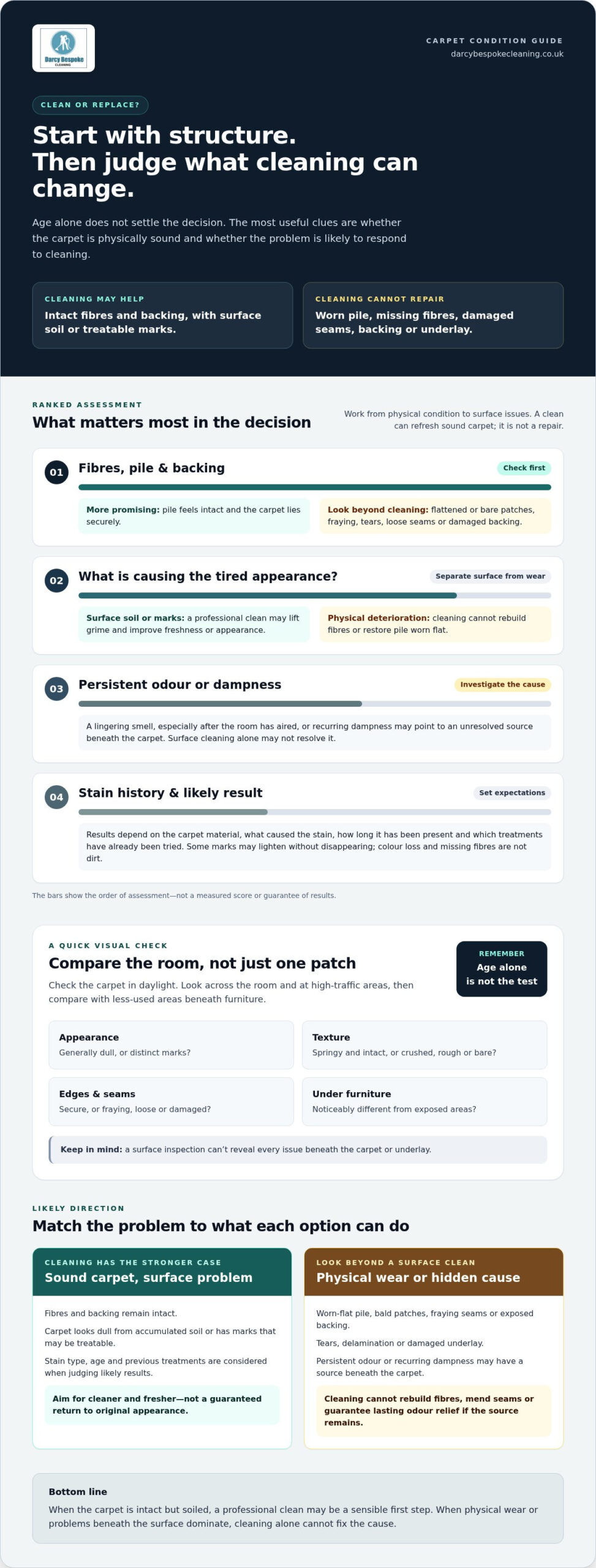
Clean or Replace Carpet: A Practical Assessment
A room-by-room check can make the choice clearer. Work through these steps and note what you find, rather than relying on one stubborn mark or the carpet’s age to decide whether is it better to clean or replace old carpet.
- Inspect the fibres. Look at busy routes, doorways and areas around furniture. Compare them with less-used sections. Note whether the pile is merely flattened or actually thinning, bald or missing.
- Check the backing and edges. Look for rippling, loose seams, fraying or backing visible at the edges. Don’t pull at fibres or lift the carpet to investigate; record what you can see safely.
- Identify odours or dampness. Note where smells are strongest and whether they persist after airing the room. In Fife, dampness is worth taking seriously, but it doesn’t automatically mean the carpet is the source. Consider the room and any possible underlying cause rather than masking the smell.
- Assess how the room is used. Is the carpet still comfortable and suitable for the household? Consider whether its condition affects everyday use, or whether the main concern is appearance.
A room-by-room carpet inspection
Check the whole room, not just the most noticeable stain. Compare high-traffic routes with areas beneath furniture, and inspect doorways, furniture edges and seams. A brief note or simple room sketch can help you record thinning, rippling, marks and odours by location. This makes it easier to distinguish isolated soiling from widespread wear and to see whether several problems are concentrated in one area.
What to consider before committing to either option
Write down previous cleaning or stain treatments, including what was treated and whether the marks returned. A recurring mark may respond differently from a new one, and that history helps set realistic expectations. Then separate appearance issues that may be cleanable from fibre loss, damaged backing or a possible moisture source.
Base your decision on the carpet’s condition, comfort and likely outcome, not its age alone. If it remains suitable and the main issue is surface soiling, cleaning may be a practical next step. If damage is extensive or the carpet no longer works for the room, replacement may make more sense. For upkeep guidance after either decision, see Expert Carpet Care Tips.
If your inspection suggests the carpet is intact but needs refreshing, arrange domestic carpet cleaning in Fife with Darcy Bespoke Cleaning.
A professional carpet clean in Fife: a considered next step
If the carpet is intact and the main concern is soil or staining, professional cleaning may be a practical way to refresh it. Extensive thinning, tears, loose seams or damaged backing point to physical deterioration that cleaning can’t repair. Persistent dampness or odours also deserve attention to their source before you treat them as a surface-cleaning problem.
This condition-first approach helps answer the question, is it better to clean or replace old carpet, without expecting cleaning to solve problems it cannot reach. Darcy Bespoke Cleaning provides domestic carpet cleaning for homes in Fife and surrounding areas when the carpet is sound but needs a refresh.
What a tailored professional clean can offer
The service includes stain pre-treatment followed by high-powered extraction, using equipment including the Alltec Advance 600 and Rotovac 360i. Treatment should reflect the carpet material, its condition and the concerns identified, such as general soiling or particular marks. The aim is to refresh suitable carpet, not to make a worn or damaged one new again.
Darcy Bespoke Cleaning also offers a 100% satisfaction guarantee: if you’re not completely happy, you can request a free re-clean. This gives you an opportunity to have the cleaning revisited while keeping expectations grounded in the carpet’s condition and the limits of cleaning.
Choose your next step with realistic expectations
Consider a professional clean when the fibres and backing remain sound and dirt or staining is the main issue. If the carpet has substantial physical damage, or a smell returns alongside signs of dampness, investigate the underlying problem rather than relying on cleaning to mask it. These distinctions can help you avoid treating wear as dirt or replacing a carpet that may still be refreshed.
For a considered next step, explore bespoke carpet cleaning in Fife with Darcy Bespoke Cleaning.
Choose the next step with confidence
The answer to “is it better to clean or replace old carpet” depends on its condition, not simply how long it’s been down. If the fibres and backing are sound and soil or treatable staining is the main concern, a professional clean may refresh the carpet. Extensive wear, damage or an unresolved source of dampness calls for a different response.
For homes across Fife and surrounding areas, family-run Darcy Bespoke Cleaning uses professional equipment including the Alltec Advance 600 and Rotovac 360i. The business also offers a 100% satisfaction guarantee: if you’re not completely happy, you can request a free re-clean. Cleaning can make a meaningful difference to suitable carpet, while realistic expectations help you decide when it’s time to replace.
Ready to refresh carpet that’s still in good condition? Explore bespoke carpet cleaning in Fife with Darcy Bespoke Cleaning.
Frequently Asked Questions
Is it worth professionally cleaning a 20-year-old carpet?
It can be, if the fibres and backing remain sound and the main issue is accumulated soil or treatable staining. Age alone doesn’t determine whether a clean is worthwhile. Check for thinning, bald patches, loose seams, persistent odours and signs of dampness first. A professional clean may refresh serviceable carpet, but it won’t restore worn fibres or repair structural damage. The likely result depends on the material and its cleaning history.
Can professional carpet cleaning make old carpet look new again?
Usually, you shouldn’t expect old carpet to look exactly as it did when new. Cleaning can lift soil and improve freshness when the carpet is in sound condition, but it can’t replace missing fibres, restore flattened pile or reverse bleaching. Stains may also remain, depending on their cause and previous treatment. A realistic aim is a cleaner-looking carpet, not a guaranteed transformation to its original appearance.
How do I know if my carpet needs replacing?
Look for widespread thinning, bald patches, fraying seams, tears, rippling or backing that’s exposed or deteriorating. These signs suggest physical wear that cleaning can’t repair. A lingering musty smell or recurring dampness also deserves investigation, since the cause may be beneath the carpet or unrelated to it. If the carpet remains intact and the main problem is soil or staining, cleaning may still be worth considering before replacement.
Does carpet cleaning remove old stains permanently?
Not always. The result depends on the stain, carpet fibre, how long the mark has been present and what products or treatments have already been used. Some stains may lighten or lift, while others can remain or reappear after cleaning. Bleaching and colour loss aren’t removable dirt, so cleaning can’t restore the original colour. Share the stain’s history before treatment to help set realistic expectations.
Can carpet cleaning get rid of a persistent musty smell?
It may help if the odour is held in soil within otherwise sound carpet, but cleaning can’t guarantee lasting relief when moisture or contamination remains underneath. A smell that returns, or accompanies dampness, calls for investigation of the source rather than repeated surface treatment. Don’t assume the carpet itself is responsible. Once the underlying issue is addressed, a professional clean or deodorising treatment may help refresh suitable carpet.
Is it better to clean or replace carpet after a spill?
A spill doesn’t automatically mean the carpet needs replacing. Act promptly by gently blotting the area with a clean, absorbent cloth, rather than rubbing, which can spread the stain or disturb fibres. The best treatment depends on the spill and carpet material. If the carpet remains structurally sound, professional stain pre-treatment and extraction may improve the mark. Consider replacement only if the spill has caused extensive damage or an unresolved underlying problem.
How often should old carpet be professionally cleaned?
Follow the carpet manufacturer’s care instructions, particularly if the carpet is still under warranty. Some manufacturers recommend professional deep cleaning using hot water extraction every 12 to 18 months as a warranty condition. Household use, visible soiling and the carpet’s material may also affect when a clean is appropriate. For older carpet in Fife, base the decision on both its condition and its care guidance, rather than age alone.