
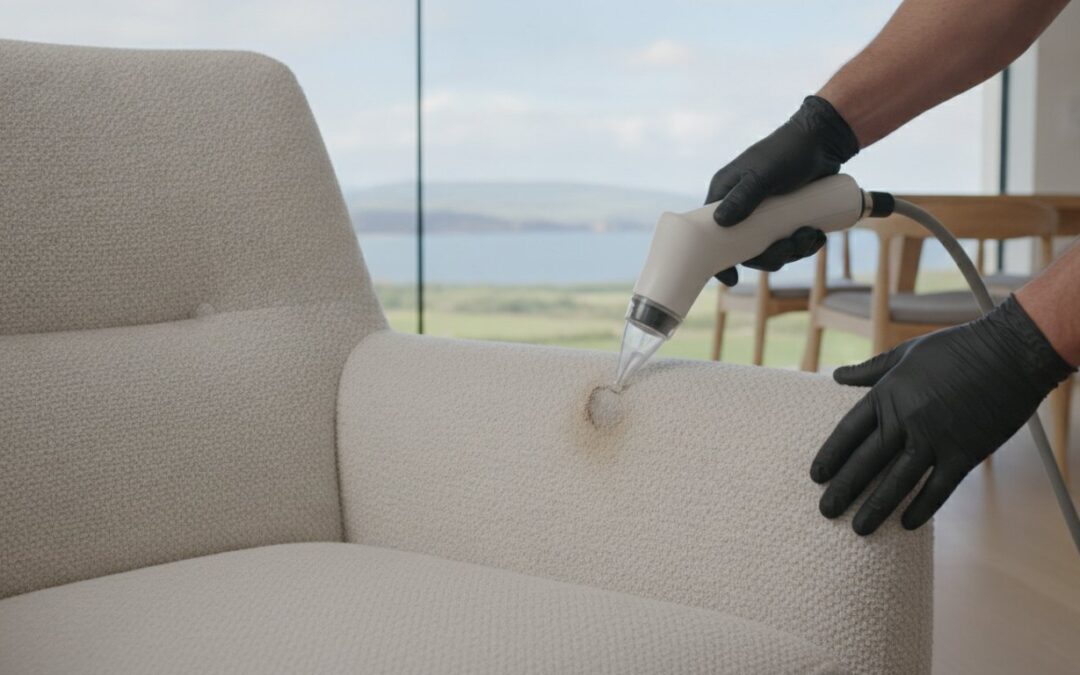
A single, dark droplet of ink on a cherished armchair can feel like a permanent scar on your home’s aesthetic harmony. It’s a moment that often triggers a frantic search for solutions, yet the challenge of removing ink from upholstery Fife residents face is rarely solved with a simple cloth and water. You’ve likely encountered a mountain of conflicting DIY advice online, each carrying the risk of setting the stain forever. Your fine furniture represents more than just a seat; it’s a carefully chosen element of your private environment that deserves expert protection.
We understand the deep anxiety that comes with protecting bespoke furniture from lasting discolouration. Your investment requires a measured, professional approach that respects the integrity of every fiber. This guide reveals how to safely manage the initial spill and when to entrust your piece to a dedicated fabric custodian. We’ll examine the technical standards, such as PAS 86:2008, that guide expert restoration. You’ll discover how professional stewardship provides the peace of mind that comes from true craftsmanship and decisive results.
Key Takeaways
- Master the vital first steps of ink management by learning the proper blotting techniques that prevent pigments from bonding permanently with your fabric.
- Navigate the complexities of furniture care labels with a clear guide to decoding the specific cleaning requirements of your bespoke pieces.
- Protect the integrity of your furniture by uncovering the hidden risks associated with common household hacks like hairspray and acidic cleaners.
- Explore the precision chemistry and advanced extraction methods required for removing ink from upholstery Fife residents trust to preserve their luxury interiors.
- Secure the future of your environment with insights into professional fabric protection and our commitment to meticulous restoration standards.
Immediate First Aid: What to Do the Moment Ink Hits Your Upholstery
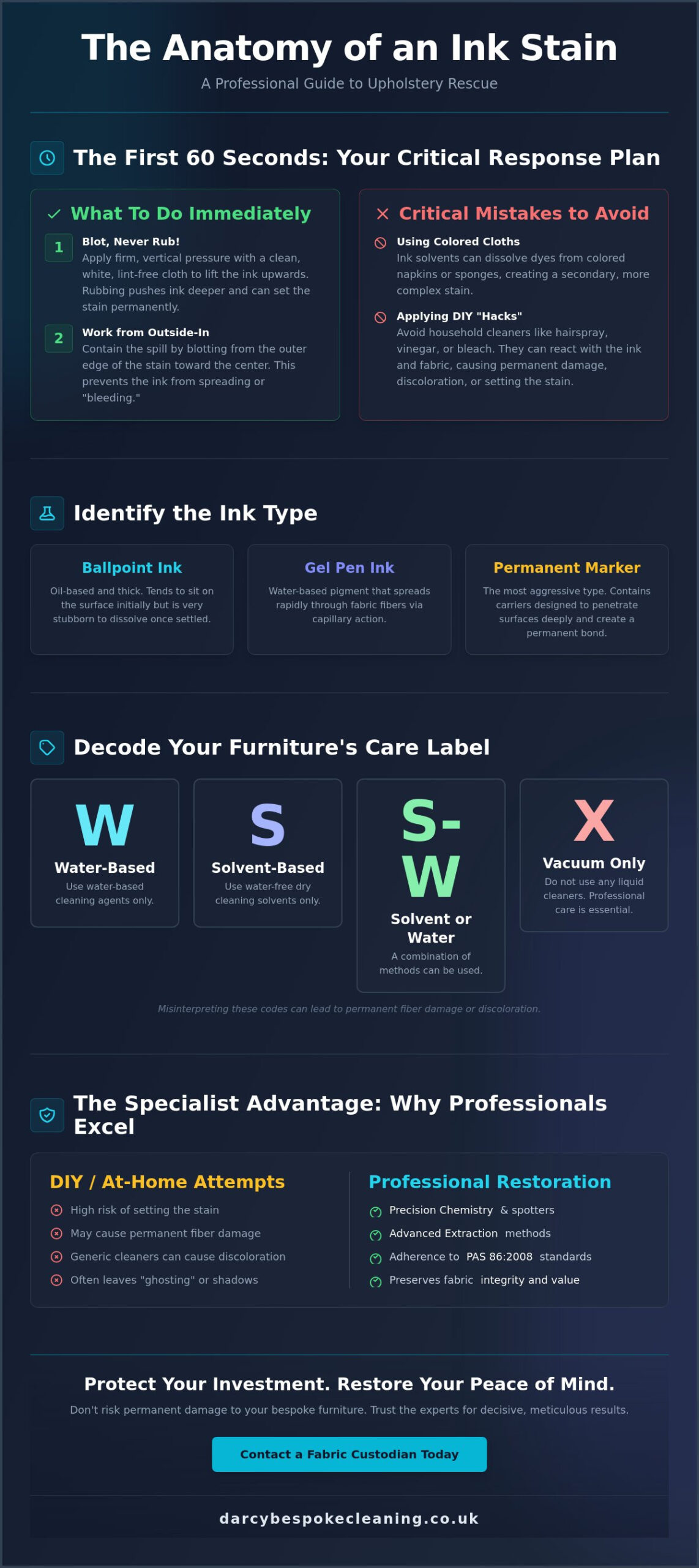
The instant a pen leaks or a marker slips, your furniture enters a state of crisis. Because ink is essentially a concentrated dye, it seeks to form a permanent bond with the fibres of your upholstery almost immediately. For those removing ink from upholstery Fife residents often feel a surge of panic, yet the first sixty seconds are the most critical for preservation. The golden rule is absolute: you must blot, never rub. Rubbing creates friction that generates heat and physical force, driving the pigment deeper into the weave and potentially into the internal padding where it becomes inaccessible to standard cleaning methods.
To begin the recovery, use only white, lint-free cloths or plain paper towels. Coloured sponges or patterned napkins are a significant risk; the solvents in the ink can actually dissolve the dyes in the towel, leading to a secondary stain that is even harder to treat. By applying firm, vertical pressure, you can draw the excess liquid upward. Failure to act with precision often results in “ghosting,” a permanent, faint shadow that remains even after professional intervention. Understanding the science of stain removal is essential because once an ink stain is “set” by heat or the wrong chemical, it often becomes a permanent part of the fabric’s history.
The Anatomy of an Ink Spill
Not all inks are created equal, and their chemical composition dictates how they interact with your sofa. Understanding the specific nature of the spill is the first step in successful restoration:
- Ballpoint Ink: Typically oil-based and thick, it tends to sit on the surface longer but is stubborn to dissolve.
- Gel Pens: These use a water-based pigment that spreads rapidly through capillary action.
- Permanent Markers: These are the most aggressive, as they contain carriers designed to penetrate surfaces deeply.
As the liquid sits, gravity pulls it through the fabric and into the foam or feathers below. Wicking is the process where deep-seated ink rises to the surface during drying. This phenomenon explains why a stain might seemingly disappear only to return hours later as a dark, blurred reminder of the original spill.
Creating a “Safe Zone” Around the Stain
Containment is your primary objective before the professionals arrive. For anyone removing ink from upholstery Fife specialists always recommend working from the outside of the stain toward the centre. This technique prevents the “bleeding” effect where the liquid migrates into clean, unaffected areas. By creating a perimeter with a dry, white cloth, you effectively wall off the damage. Don’t succumb to the urge to use heavy amounts of water or “natural” cleaners like vinegar at this stage. Excess moisture acts as a transport mechanism, carrying the ink particles further into the structural layers of your armchair or sofa. Maintaining a controlled environment ensures the fabric’s texture remains intact while awaiting expert restoration.
Decoding Your Furniture: Understanding Fabric Care Labels
Before you attempt any intervention, you must consult the fabric’s blueprint. This label dictates the chemical boundaries of your piece and serves as a vital safeguard against accidental damage. For those removing ink from upholstery Fife homes, misinterpreting these symbols often leads to permanent discolouration or fibre fatigue. The label is not merely a suggestion; it is a mandate for preservation. Understanding these codes allows you to move forward with the quiet confidence that you aren’t compromising the structural integrity of your furniture.
Most modern pieces feature one of four primary codes. “W” signifies that water-based cleaning agents are permissible, but this doesn’t mean the fabric is waterproof or scrub-proof. High-street detergents can still cause shrinkage or unsightly water rings. “S” indicates that only anhydrous (water-free) solvents should be used. Introducing moisture to an “S” fabric can lead to dye migration or permanent texture changes. “S-W” offers a balance of both methods, while “X” is the most restrictive, permitting only light vacuuming. These designations align with university-tested stain removal tips that highlight how specific fibres react to different chemical pH levels. Fife’s discerning homeowners often possess pieces crafted from linen, wool, or silk, materials that demand a specialized touch to avoid ruining the delicate nap.
Where to Find Your Upholstery Care Tags
Tags are often discreetly placed to maintain the furniture’s aesthetic. Check beneath the seat cushions, along the interior zip seams, or behind the black dust cover on the sofa’s underside. If a tag is missing, we employ the Darcy “Bespoke” approach to fibre identification. This includes the “Drip Test,” where a single drop of water is placed on an inconspicuous area. If the water beads, the fabric likely has a protective coating; if it sinks in and darkens the fibre, the material is highly absorbent and requires expert care. If you’re unsure of your fabric’s composition, seeking professional sofa cleaning ensures your investment is handled with the necessary stewardship.
Why “X” Marked Fabrics Require Immediate Professional Stewardship
Fabrics marked with an “X” are the most precarious. They are often found on high-end velvet or intricate silk blends where any liquid application can cause pile distortion. This occurs when the fibres are permanently crushed or tilted, destroying the fabric’s natural lustre. When removing ink from upholstery Fife specialists recognize that “X” codes represent a unique challenge that standard household tools cannot meet. We handle these high-risk materials using specialized dry-cleaning tools. These methods lift the ink pigments without saturating the delicate weave, preserving the texture and colour that make your furniture a centrepiece of your home.
The Risks of DIY Ink Removal: Why Viral Hacks Often Fail
The desire for a swift, cost-effective solution often leads homeowners to experiment with viral “hacks” found on social media. While these methods promise instant results, they frequently ignore the complex chemistry involved in removing ink from upholstery Fife residents value. The most pervasive of these is the hairspray myth. Decades ago, hairspray contained high levels of alcohol, which acted as a solvent. Today, modern formulations have evolved to include resins and polymers designed to hold hair in place; when applied to a stain, these chemicals effectively glue the ink to the fabric. Instead of lifting the pigment, you’re creating a permanent, plasticized bond that even professional extraction may struggle to break.
Similarly, “natural” remedies like vinegar and lemon juice pose their own risks. These acidic substances can act as mild bleaching agents on delicate natural fibres. If you check a comprehensive stain removal chart, you’ll notice that different pigments require specific pH environments for safe release. Applying an acid to an alkaline-sensitive dye can cause immediate, irreversible colour loss. The use of high-concentration rubbing alcohol often leads to over-saturation. If this solvent reaches the foam padding beneath the fabric, it can dissolve the polyurethane structure, leading to a collapsed cushion or a secondary “solvent ring” that migrates outward.
The Chemistry of Permanent Damage
When you apply friction or heat to an active ink spill, you’re providing the energy needed for dye molecules to penetrate the core of the fibre. This physical agitation “sets” the stain, turning a surface-level issue into a structural one. Many well-intentioned DIY attempts involve mixing multiple household cleaners, creating “chemical cocktails” that can lead to irreversible fabric melt. It’s a delicate balance that requires precision. Professional pH balancing is the only way to neutralise cleaning agents after use.
Residue: The Silent Sofa Killer
One of the most overlooked consequences of DIY cleaning is the lingering residue. Most household soaps and sprays are designed to be “sticky” so they can cling to dirt. If you don’t remove 100% of these agents, they remain in the weave, acting as a magnet for airborne dust and skin oils. This results in a dark, grimy patch that appears weeks after the ink is gone, proving that the specialized process of removing ink from upholstery Fife professionals provide is essential for a lasting result. Professional stewardship focuses on “rinsing” as much as “cleaning.”
Professional Ink Extraction: The Specialist Advantage in Fife
While initial blotting is a necessary reflex, it can only address the ink sitting on the surface. For truly removing ink from upholstery Fife homeowners must recognize the “Point of No Return.” This is the moment where manual dabbing reaches its physical limit and any further pressure only serves to push the pigment deeper into the structural padding. Our specialized approach utilizes the Alltec Advance 600, a piece of high-performance machinery designed for deep-fibre extraction. Unlike household tools, this system applies a precise balance of heat and high-powered vacuum pressure, drawing the ink out of the weave rather than spreading it across the surface. This level of mechanical advantage is what separates a visible shadow from a complete restoration.
The chemistry we employ is equally sophisticated. We don’t rely on generic cleaners; instead, we use professional-grade reducers and oxidisers tailored to the specific chemical signature of the ink. Whether it’s a permanent marker or a complex gel dye, our precision chemistry breaks the molecular bond between the pigment and the fibre. Because we are based locally, our response to those removing ink from upholstery Fife wide is swift. Speed is your greatest ally in preventing a stain from becoming a permanent fixture of your furniture’s history. You can secure your furniture’s future by choosing our professional stain removal treatment today.
Our Bespoke Multi-Stage Removal Process
- Dry Soil Removal: We begin by removing any dry particulates that could interfere with the chemical reaction, followed by a precise fibre identification to ensure the material can withstand the extraction process.
- Targeted Pre-treatment: A specialized solution is applied to the ink, followed by gentle mechanical agitation with a soft-bristled brush to break up the pigment clusters without fraying the fibres.
- High-Temperature Steam Extraction: Where the fabric care label permits, we use controlled steam to flush out the dissolved ink, leaving the fabric clean and neutralised.
Fast Drying Times for Fife Households
The humid Scottish climate presents a unique challenge for upholstery care. If a sofa remains damp for too long, it becomes a breeding ground for mildew and unpleasant odours. Our advanced machinery is designed to extract the vast majority of moisture during the cleaning process, reducing drying times from several days to just a few hours. This efficiency ensures your private environment is returned to its intended state of comfort and order with minimal disruption. Learn more about our fast drying times here and see how we prioritize the health of your home.
By utilizing industrial-grade air movers when necessary, we ensure that even the deepest layers of your armchair or sofa are dry before we depart. This commitment to thoroughness is a hallmark of our role as custodians of your environment. We don’t just remove the ink; we restore the harmony of the room. It’s a meticulous process that respects both your time and the value of your fine furniture.
Restoring Peace of Mind: The Darcy Bespoke Guarantee
True restoration is about more than the technical removal of a pigment; it’s about returning a sense of order and tranquility to your sanctuary. When removing ink from upholstery Fife residents often feel a lingering doubt about whether their furniture will ever truly recover. Our commitment to your home is absolute. We provide a 100% satisfaction guarantee that prioritizes your peace of mind above all else. If the ink isn’t gone and you aren’t entirely satisfied with the outcome, we’ll return to re-clean the area at no additional cost. This isn’t just a service promise; it’s a reflection of our role as dedicated custodians of your private environment.
We treat every home with the discretion and profound respect it deserves. Our experts understand that your furniture represents a significant investment in both style and comfort. By choosing a partner that values quality over volume, you ensure that your bespoke pieces are handled with the precision required for high-end materials. This professional stewardship extends beyond the initial cleaning, providing you with the confidence that your interior remains a refined space for relaxation and hosting. We don’t just clear a stain; we preserve the integrity of your living space.
Long-Term Care and Fabric Protection
The most effective way to manage future spills is to prevent them from bonding with the fibre in the first place. Following a successful ink extraction, we highly recommend the application of professional fabric protection. This treatment creates an invisible, breathable barrier around each individual fibre, significantly increasing the surface tension of the material. When a spill occurs on a protected piece, the liquid beads on the surface rather than sinking into the weave. This allows you to blot away accidents with ease, preventing the panic of a permanent mark. We can design a customized maintenance schedule tailored to the specific usage patterns of your premium upholstery, ensuring your furniture remains in pristine condition for years to come.
Contact Your Local Fife Experts
Our specialized services are available to discerning clients across the region, including St Andrews, Cupar, Dunfermline, and the surrounding villages. We believe that every piece of furniture has a unique story and requires a personalized approach to care. To begin the process of restoring your cherished armchair or sofa, we invite you to reach out for a professional assessment. We provide clear, accurate quotes based on your specific fabric type and the nature of the restoration required. Request your bespoke upholstery cleaning quote today and experience the difference that expert stewardship makes. Your furniture is in safe hands. Let us return the harmony to your home through the art of professional removing ink from upholstery Fife specialists provide.
Securing the Future of Your Fine Furniture
An ink spill doesn’t have to be the final chapter for your cherished furniture. By recognizing the limitations of viral home remedies and the critical importance of fabric care labels, you’ve already taken the first steps toward preservation. The specialized process of removing ink from upholstery fife homeowners trust requires more than just simple soap; it demands the precision of advanced Alltec and Rotovac technology. As a family-run business with deep local expertise, we provide the meticulous stewardship your home deserves.
Our 100% Satisfaction Guarantee ensures that your investment is protected by high standards and professional integrity. We understand that your furniture is a central part of your private sanctuary. Don’t let a temporary accident lead to permanent discolouration or the unnecessary cost of replacement. Restore your upholstery with Fife’s specialist cleaners—Get a Quote today. We look forward to returning the quiet elegance and harmony to your living environment with grace and efficiency.
Frequently Asked Questions
Is it possible to remove permanent marker from a sofa?
Yes, successful removal is often achievable through the use of specialized reducing agents that break down the resilient pigments. Unlike ballpoint ink, marker dyes are designed to be permanent, so they require a professional’s touch to avoid spreading the stain across the weave. We assess the fabric’s integrity first to ensure the treatment is as safe as it is effective for your specific piece.
Will professional cleaning ruin the texture of my velvet or wool upholstery?
Our restoration process is specifically engineered to protect the delicate nap of luxury fabrics like velvet and wool. We use controlled moisture levels and gentle mechanical agitation to ensure the texture remains soft and the fibres stay upright. This specialized stewardship prevents the crushing or matting often associated with amateur cleaning attempts, preserving the original hand-feel of your fine furniture.
How much does it cost to have a single ink stain removed in Fife?
The investment for professional restoration varies based on the fabric’s composition and the extent of the ink migration. Because every piece of furniture is unique, we provide bespoke quotes following a brief assessment of the damage. This ensures you receive a fair price tailored specifically to the technical requirements of your armchair or sofa without any hidden surprises.
Can I use a steam cleaner from a hire shop on ink stains?
Using a hired steam cleaner is often counterproductive because the high heat can permanently set the ink into the fibres. These machines frequently lack the high-powered vacuum extraction needed to pull pigments out, which often results in a larger, blurred stain. For removing ink from upholstery fife residents should rely on industrial-grade equipment that balances temperature and suction with precision.
What should I do if I already tried hairspray and it didn’t work?
If a DIY attempt has failed, the most important step is to stop applying additional chemicals which may cause an irreversible reaction. Blot the area with a clean, dry white cloth to remove any remaining residue and contact a professional immediately. We can often still achieve results, provided the fabric hasn’t been structurally compromised by the resins found in modern hairspray formulas.
How long does the upholstery take to dry after a professional clean?
Thanks to our advanced Alltec extraction machinery, most pieces are touch-dry within two to six hours. The exact time depends on the fabric’s density and the ambient humidity in your home. We prioritize efficient moisture removal to ensure your living space is returned to its intended state of comfort and order as quickly as possible, minimizing any disruption to your day.
Do you provide upholstery cleaning in St Andrews and Dunfermline?
We proudly serve the entire region, including St Andrews, Dunfermline, Cupar, and the surrounding coastal villages. Our local presence ensures we can respond swiftly to emergencies involving removing ink from upholstery fife wide. This promptness is vital in preventing ink from forming a permanent bond with your furniture, allowing us to act as effective guardians of your interior environment.
Is the cleaning solution you use safe for pets and children?
Every restoration agent we utilize is selected for its professional integrity and safety for both children and pets. We prioritize sophisticated, non-toxic chemistry that provides significant results without leaving harmful residues behind in your home. Your family’s well-being and the cleanliness of your private environment are our primary concerns, ensuring a result that is both beautiful and perfectly safe.