
The lowest-priced spot cleaner isn’t automatically the best upholstery cleaner for pet urine: the right choice depends on whether the stain is fresh or dried, the fabric, and the cleaner’s suitability for upholstery. Comparative spot-cleaner tests included fresh stains and stains dried for 12 hours, with each cleaner given two minutes of initial cleaning. Those conditions offer a useful way to judge performance, but they don’t mean every cleaner was tested on pet urine.
It’s understandable to want one product that lifts the mark and tackles lingering odour without putting delicate upholstery at risk. This guide compares spot-cleaner prices and specifications, explains what to look for when treating fresh and dried urine, and shows how to read test results with care. You’ll also find a straightforward decision guide to help weigh stain performance against upholstery suitability, ease of use and cost, so you can choose a more considered approach for your furniture.
Key Takeaways
- Compare spot cleaners by upholstery suitability and the stain they’re intended to tackle, not price alone.
- Use test conditions as context: comparisons included fresh marks and stains dried for 12 hours, with two minutes of initial cleaning for each spot cleaner.
- Check product specifications and directions to understand how a cleaner is meant to be used on upholstery.
- Consider how enzyme-based formulas are intended to address pet urine, and what that means for choosing a treatment.
- For persistent marks on upholstered furniture, professional sofa or armchair cleaning is another option to consider.
Spot cleaner recommendations for pet stains
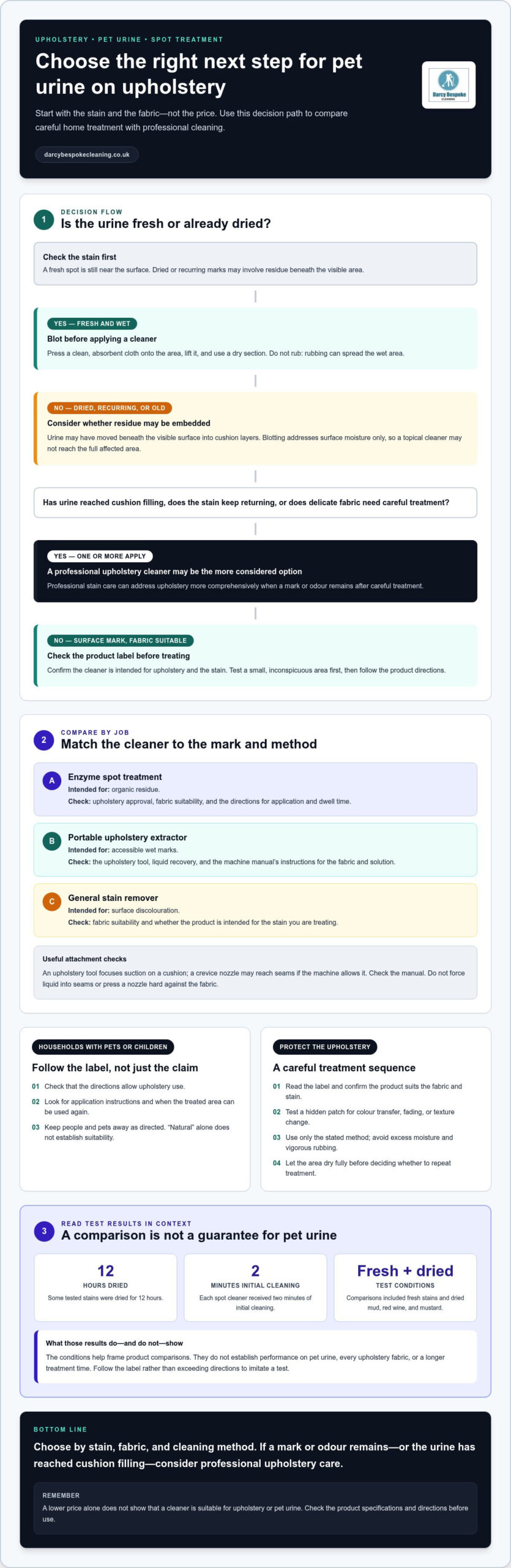
Hire a professional upholstery cleaner when urine has reached cushion filling, a stain keeps returning, or delicate fabric needs careful treatment. For surface marks, compare a cleaner’s upholstery instructions, stain approach and attachments before choosing.
Old and Embedded Pet Stains
An old stain differs from a fresh spot because urine may have moved beneath the visible surface into cushion layers. Blotting addresses surface moisture only, so a topical cleaner may not reach the full affected area. Follow the upholstery care label and product directions, and avoid repeatedly soaking one patch. If odour or discolouration remains after careful treatment, professional stain removal can address the upholstery more comprehensively.
Cleaner Safety for Pets and Children
For households with cats, dogs or children, choose products by their label directions, not claims such as “natural” alone. Check that the instructions allow upholstery use, explain how to apply the product and say when the treated area can be used again. Keep people and pets away as directed. A spray treats the surface, while an extractor applies cleaning solution and recovers liquid.
Enzyme Action on Upholstery Urine
Enzyme cleaners are formulated to act on organic residues, unlike products focused mainly on lifting visible marks. The directions explain where to apply the solution and how long to leave it before blotting or extraction. Upholstery fibres and cushion layers affect how far it can reach, so surface application may not remove embedded residue. Use an enzyme formula only when its label allows the specific fabric and cleaning method.
For fresh urine, blot with an absorbent cloth before applying a suitable cleaner; rubbing can spread the wet area. Then follow the label’s method and use a clean cloth or extractor only as directed. Comparative spot-cleaner tests included fresh stains and stains dried for 12 hours, with two minutes of initial cleaning for each spot cleaner. Those test conditions help frame comparisons, but don’t establish performance on every upholstery fabric.
| Option | Best suited for | Compare |
|---|---|---|
| Enzyme spot treatment | Organic residue | Upholstery approval and directions |
| Portable upholstery extractor | Accessible wet marks | Upholstery tool and liquid recovery |
| General stain remover | Surface discolouration | Fabric suitability and intended stains |
Choose a cleaner that suits the stain, fabric and cleaning method, and follow its label.
Attachments can make treatment more controlled: an upholstery tool focuses suction on a cushion, while a crevice nozzle may reach seams if the machine allows it. Check the manual for the correct attachment and solution. Don’t force liquid into seams or press a nozzle hard against the fabric. Test a small, inconspicuous area first to check for colour change.
Testing on fresh and dried stains
Yes, a pet urine cleaner can discolour or damage upholstery if its formula or application doesn’t suit the fabric. Test an inconspicuous area first, follow the label and avoid excess moisture or vigorous rubbing.
Test conditions matter. Comparative spot-cleaner tests assessed fresh stains and mud, plus red wine and mustard dried for 12 hours. Each cleaner received two minutes of initial cleaning. These details show how products were compared, but the reported stains don’t establish how every formula performs on pet urine or every upholstery fabric.
For a useful comparison, distinguish between fresh and dried stains. Fresh urine is still near the surface, while dried residue has had longer to settle into fibres. A product’s performance on fresh mud or wine doesn’t predict how it will work on either type of urine stain. Check that it’s labelled for upholstery and pet stains.
For a fresh mark, use this careful sequence:
- Blot first. Press a clean, absorbent cloth onto the wet area. Lift it, then use a dry section rather than rubbing the stain outward.
- Read the label. Confirm that the cleaner is intended for upholstery and follow its dilution and application instructions.
- Test discreetly. Apply the product to a hidden patch, then inspect for colour transfer, fading or texture change.
- Treat the mark. Work within the stated treatment area and remove residue only as the directions specify.
Blot a fresh spot gently to protect the fabric and limit its spread. For example, blot a cushion rather than pressing liquid into its seams. If using an extractor, follow its upholstery instructions: a carpet setting may not suit sofa fabric.
Read test results for dried stains with care. A cleaner used for two minutes may not perform the same with a longer dwell time or repeated applications. Don’t exceed the label’s directions to imitate a test. Instead, check whether the instructions cover set-in marks and assess the stain after using the recommended method.
Fabric type affects the risk. A colourfast synthetic cushion and a delicate woven fabric can respond differently to the same solution. Testing a hidden patch can reveal immediate changes; let the area dry fully before deciding whether to repeat the process.
If home treatment leaves a visible mark, professional upholstery stain care offers a considered next step for fabric that needs a more controlled approach.
Spot cleaner prices and product specifications
When comparing spot cleaners, weigh the price against the features you’ll actually use. The best upholstery cleaner for pet urine should suit the fabric, stain and cleaning method, not simply have the longest specification list. Compare UK products on a like-for-like basis, checking prices in pounds sterling and whether the listing covers the machine, solution or both.
Start with the cleaner type. A ready-to-use spray needs no machine, while a portable extractor applies solution and recovers liquid. Concentrated formulas may need dilution, so the bottle price alone won’t show how much a treatment costs. Check the label for upholstery suitability, dilution instructions and the stains it names.
Specifications can show how practical a machine is around furniture. Look for an upholstery attachment, hose arrangement, separate solution and recovery tanks, and instructions for cleaning or storing the tool. A compact hand tool, for example, may reach a sofa seat more easily than a broad floor head. Tank capacity affects how often you pause to refill or empty, but doesn’t prove stain-removal performance.
| Option | Price comparison | Specifications to examine | Useful for |
|---|---|---|---|
| Upholstery spray | Compare the stated bottle price and quantity | Fabric suitability and application directions | Targeted surface treatment |
| Concentrated solution | Include dilution instructions in the comparison | Compatible machines and upholstery guidance | Use with a suitable cleaning system |
| Portable extractor | Separate machine cost from solution costs | Upholstery tool, tanks and hose | Applying and recovering liquid |
Match each option to the task rather than assuming a higher price means stronger cleaning. A spray and an extractor do different jobs, so comparing their prices directly can mislead. Note the product format, stated quantity and included attachments for each listing. Compare products in the same category, such as extractor with extractor, rather than spray with machine.
For a purchase decision, use this checklist:
- Fabric: confirm the directions include upholstery, not only carpet.
- Pet stain: look for explicit guidance on urine or organic stains.
- Application: identify whether the formula is ready to use or diluted.
- Tools: check whether an upholstery attachment is included or separate.
- Running needs: note solution refills, cleaning instructions and storage requirements.
A product page may show a headline price without making the format clear. Check whether it describes a spot solution, a machine or a bundle, then compare the stated specifications. This keeps your decision focused on the features and costs relevant to your upholstery.
How do enzyme cleaners work on pet urine in upholstery?
Enzyme cleaners use enzymes to break down organic residues in pet urine, rather than simply masking the smell. Results depend on the formula reaching the residue and being used as directed. On a sofa cushion, urine may remain in the fabric, beneath its surface or inside the filling. A surface spray may not reach every affected layer.
Different enzymes act on different types of material. A product’s formulation determines which residues it targets, so “enzyme cleaner” alone doesn’t describe its performance. Check the label for pet urine, upholstery suitability, application method and any stated contact time. A formula intended for hard surfaces, for example, may not suit a woven chair seat.
Use the product in a controlled sequence:
- Remove excess moisture. For a fresh spot, blot with an absorbent cloth before applying solution.
- Check the fabric. Test a hidden patch and look for colour transfer or a change in texture.
- Apply as directed. Follow the label’s instructions for coverage, dilution and contact time.
- Allow the stated action time. Don’t wipe or extract earlier unless the directions say to do so.
- Finish as instructed. Use a clean cloth or suitable machine only if the product directions permit it.
Coverage matters. If urine has reached the cushion filling, the visible mark may be smaller than the affected area. Applying enzyme solution only to the surface can leave residue below it, while flooding the cushion risks prolonged dampness. Follow the product’s application guidance and consider the upholstery construction before treating a deep stain.
Enzyme treatments differ from fragrance-based products. A scent can make a room smell fresher without addressing the underlying residue. Read the ingredients and claims carefully: an enzyme formula is intended to act on organic material, while a deodoriser may focus on odour. Neither description alone tells you whether the product suits a particular fabric.
Let the treated area dry as directed before assessing it. A damp cushion can smell different from a dry one, so judging too early may lead to unnecessary repeat applications. If the label permits another treatment, follow its instructions rather than increasing the amount or contact time yourself. Repeatedly layering products can leave residue and complicate later cleaning.
For a dried urine mark, the key decision is whether the cleaner can reach the affected upholstery layers without over-wetting them. Compare the product’s stated use, application instructions and fabric compatibility. A carefully chosen enzyme cleaner can address organic residue; the label and the cushion’s construction guide how to apply it.
Which upholstery cleaners are safe for cats, dogs and children?
Don’t assume a cleaner is safe for cats, dogs or children simply because its label says “natural” or “gentle”. Choose a product whose instructions allow upholstery use, then follow its application, drying and re-entry directions. A pet urine formula intended for hard flooring may not suit a fabric sofa.
Read the full label before opening the bottle. Check the intended surfaces, application method, ventilation advice, warnings and instructions for keeping people and animals away during treatment. Follow any drying requirement before letting a child sit on the cushion or a pet return to its usual resting place. Keep the container and any diluted solution out of reach.
Use a measured approach on the furniture:
- Identify the fabric. Check the upholstery care label and cleaner instructions for compatibility.
- Test discreetly. Apply the cleaner to a hidden patch and inspect for colour transfer or texture change.
- Apply only as directed. Avoid adding extra solution or combining products.
- Keep the area clear. Follow the label’s directions for access, ventilation and drying.
- Store the product safely. Close the container and put it away after use.
A spray used on a chair seat may leave the fabric damp, and a machine can also leave moisture after extraction. Don’t assume either area is ready for contact because it looks clean. Follow the product’s drying guidance and keep children and pets away until its stated conditions are met.
Never mix a pet urine cleaner with another product unless both labels explicitly direct that method. Formulas can behave differently on upholstery, and combining them makes their use harder to control. A fragrance-free claim doesn’t replace fabric directions or safe-use instructions. Choose by the label’s stated use, not by a reassuring description alone.
Consider the cushion itself. A removable cover may have care instructions separate from the inner filling, while a fixed seat needs treatment in place. A surface test can reveal an immediate fabric reaction, but it can’t show how a product will behave throughout a deep cushion. Use only the application method specified for that material.
If a stain has reached deep into a sofa or armchair, professional treatment can reduce the need for repeated home applications. Arrange professional upholstery cleaning for considered care of pet-affected fabric.
Darcy Bespoke Cleaning: Domestic Carpet Cleaning
Darcy Bespoke Cleaning provides Sofa Cleaning and Armchair Cleaning for pet-affected upholstery that needs professional attention. Choose this service when a mark remains after careful home treatment, urine has reached a cushion, or you’re concerned about applying another product to the fabric. Professional cleaning can be tailored to the upholstery and stain. If pet accidents have also affected carpets, Darcy Bespoke Cleaning provides Domestic Carpet Cleaning in Fife.
For upholstery that needs careful attention, contact Darcy Bespoke Cleaning to arrange Sofa Cleaning or Armchair Cleaning in Fife.
Choose a considered next step for your upholstery
Choosing the best upholstery cleaner for pet urine is part of caring for the furniture you rely on every day. The next step is to decide whether you’re comfortable treating the affected fabric yourself or would prefer professional attention. That choice can also guide how you approach future spills, including which product suits your upholstery and where you’ll use it.
Darcy Bespoke Cleaning offers Sofa Cleaning for pet-affected upholstery, alongside Domestic Carpet Cleaning and Commercial Carpet Cleaning. If you’d like a professional approach for your home or business, contact Darcy Bespoke Cleaning to discuss the cleaning you need.
A calm, considered decision helps you care for your furnishings with confidence. Choose the next step that suits your home.
Frequently Asked Questions
What is the best upholstery cleaner for pet urine in the UK?
The best upholstery cleaner for pet urine is labelled for both pet stains and your specific upholstery fabric. Check its application instructions, then test it on a hidden area before treating a visible mark. If urine has reached a sofa cushion or remains after home treatment, professional Sofa Cleaning is another option. Darcy Bespoke Cleaning provides upholstery cleaning for domestic customers across Fife.
Which upholstery cleaners remove pet urine odour and stains most effectively?
Choose a product that explicitly addresses pet urine, organic residue and odour, and is suitable for upholstery. A fragrance that masks smells doesn’t necessarily address the residue causing them. Check the instructions for fabric compatibility and application, then assess the dried area rather than judging while it’s damp. If a stain remains, a separate professional stain treatment may be appropriate for the affected fabric.
What are the best-rated pet urine upholstery cleaners available in the UK?
There’s no reliable way to name one best-rated cleaner without comparing current UK product ratings and the evidence behind them. Look for reviews that describe use on upholstery and pet urine, not carpet alone. Check whether reviewers mention odour as well as visible marks. A high general rating is less useful if the product label doesn’t support your fabric or cleaning method.
How much do pet urine upholstery cleaners cost in the UK?
Retail prices vary by product format and quantity. A ready-to-use spray, concentrated solution and portable extraction machine are different purchases, so compare like with like. Check whether a listed price covers cleaning fluid alone or includes equipment and attachments. Professional upholstery cleaning is priced according to the item, fabric and treatment required, with a quote provided on request.
How to remove fresh pet urine from a sofa step by step?
Blot fresh urine promptly with absorbent towelling, working gently towards the stain’s centre. Don’t scrub or use abrasive material. Apply a fabric-compatible cleaner according to its label without over-wetting the sofa. If flushing is needed, use clean, warm water, never hot water, then absorb moisture with fresh towelling. Let the area dry before assessing the result or repeating a product treatment.
How to remove old or dried pet urine from upholstery?
For a dried mark, avoid scrubbing or flooding the upholstery. The visible spot can understate how far urine has spread: Darcy Bespoke Cleaning’s guidance notes that a 3-inch surface stain can expand to a 10-inch sub-surface area. Follow a cleaner’s upholstery directions and avoid layering products. If residue has reached the cushion or remains after treatment, professional Sofa Cleaning or Stain Removal Treatment can address the affected furniture.