
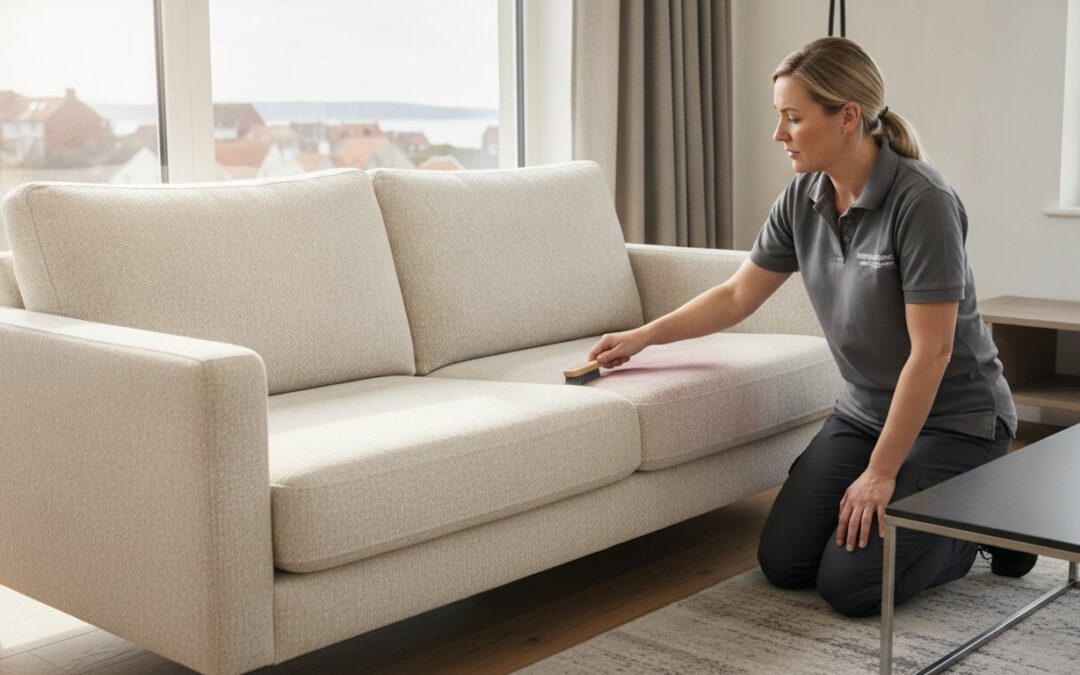
What if the very act of trying to save your cherished upholstery actually seals a mark’s fate as a permanent resident of your home? It’s a common anxiety for many Fife homeowners; the sight of a stubborn mark in a high-traffic area often leads to a frantic search for DIY solutions that may ultimately cause more harm than good. You likely wonder, will professional cleaning remove all stains, or is that unsightly blemish now a permanent part of your living space? We understand the deep respect you have for your private environment and the desire to maintain its pristine condition.
We recognize that your home is a sanctuary, and an unexpected mark can feel like a disruption to your peace of mind. You deserve a space that reflects order and harmony, free from the embarrassment of lingering spills. In this guide, we promise to reveal the scientific reality of stain removal and the precise expertise required to restore delicate fibres. You’ll gain a clear understanding of the limitations of modern chemistry and how a professional steward can provide the transformation your home deserves.
Key Takeaways
- Discern the vital difference between a surface-level spot and a permanent stain, allowing you to set realistic expectations for your home’s aesthetic restoration.
- Uncover the honest truth regarding whether professional cleaning will remove all stains, focusing on the chemical relationship between liquid contaminants and specific fibre types.
- Compare the limitations of DIY hire machines against the industrial precision of professional equipment, highlighting the importance of heat and suction in deep-fibre care.
- Recognize the “point of no return” for certain marks, such as bleach burns or aged tannins, to avoid the frustration of ineffective DIY interventions.
- Learn how a tailored, multi-stage protocol provides a more sophisticated and effective alternative to generic, one-size-fits-all cleaning methods.
Managing Expectations: Can Every Mark Be Erased?
When a spill occurs on a cherished rug or sofa, the immediate question for most homeowners is whether the mark can be erased entirely. It’s a natural concern. You’ve invested in a refined living environment and want to maintain its harmony. While we aim for perfection, the question of whether professional cleaning will remove all stains involves a complex interplay of chemistry and timing. A reputable technician adopts a policy of professional integrity; they’ll never promise total removal without a physical inspection of the affected fibres. This honesty serves as the foundation of our stewardship over your home.
The age of a spill often dictates the likelihood of a successful restoration. As time passes, liquid contaminants penetrate deeper into the core of the yarn, making them significantly harder to extract. Perhaps more critical is the role of previous DIY attempts. Many off-the-shelf cleaners contain high-pH chemicals or bleaching agents that can inadvertently “set” a mark. Once a substance is chemically bonded to the fibre through improper treatment, it may become a permanent fixture of the fabric.
The Distinction Between Spots and Stains
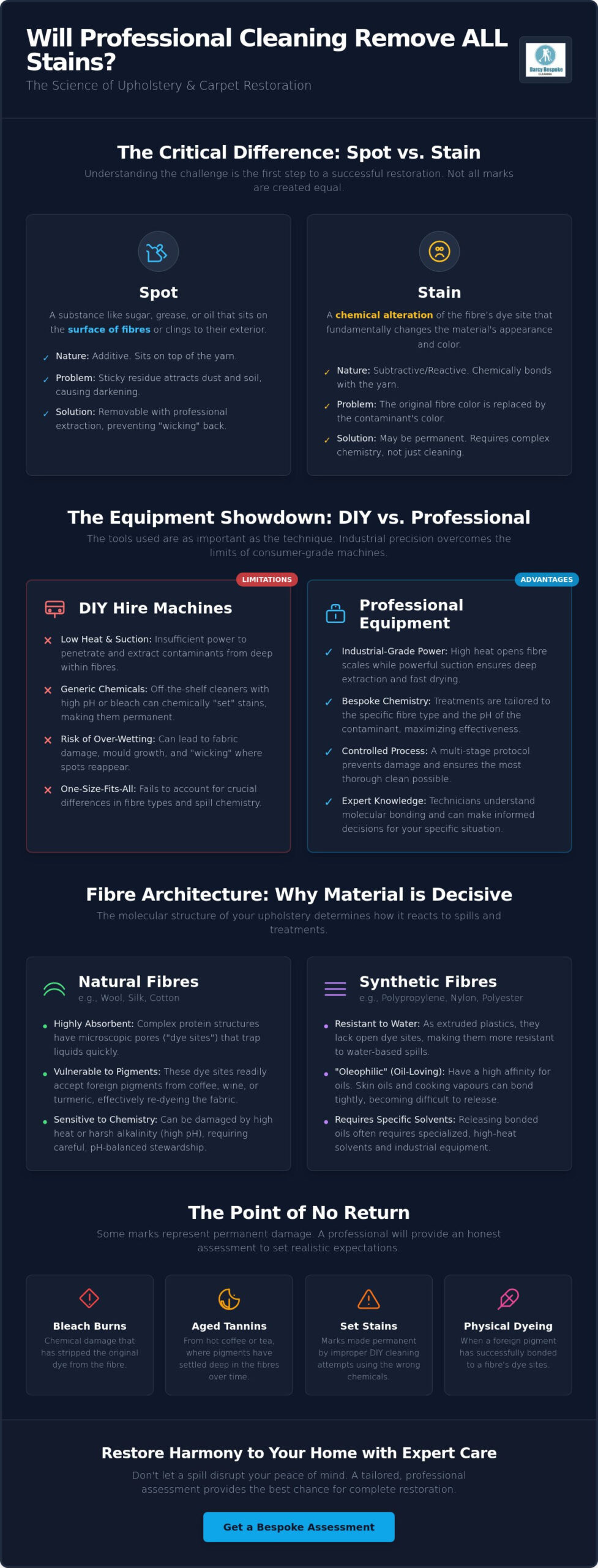
Many people use these terms interchangeably, but they represent very different challenges for a specialist. A “spot” is typically a substance like sugar, grease, or oil that sits on the surface or clings to the outside of the fibre. Because these substances are inherently sticky, they attract dust and soil, causing the area to darken over time. Professional extraction removes this residue, preventing the “wicking” effect where spots seem to reappear days later. In contrast, it is essential to understand what a stain is in a scientific context. A permanent stain is a chemical alteration of the fibre’s dye site that fundamentally changes the material’s appearance. When this happens, the original colour of the carpet has been replaced by the colour of the contaminant.
Factors That Influence Removal Success
Material composition plays a decisive role in how your floor coverings react to spills. Natural fibres like wool are highly absorbent and possess “pockets” that can trap liquids quickly, whereas synthetic materials like polypropylene are essentially plastic and resist liquid penetration. However, polypropylene is “oleophilic,” meaning it attracts oils that can be difficult to release without industrial-grade heat. The temperature of the spill also matters; hot liquids like coffee or tea can actually open the fibre scales, allowing the pigment to settle deep inside. Our bespoke assessment involves evaluating the pH of the contaminant before we apply any chemistry. By matching the right treatment to the specific spill, we maximize the chances that professional cleaning will remove all stains without risking the integrity of your delicate fabrics.
The Science of Staining: Fibre Types and Molecular Bonding
Understanding why some marks vanish while others linger requires a look beneath the surface. At a molecular level, the success of any treatment depends on how the contaminant interacts with the specific architecture of the textile. When homeowners ask if professional cleaning will remove all stains, they’re often encountering the reality of molecular bonding. Some substances merely coat the outside of a fibre, while others seek out available “dye sites” to create a permanent bond that alters the material’s identity. This distinction is the difference between a simple cleaning task and a complex restorative process.
Natural fibres like wool and silk are complex protein structures. They possess microscopic pores designed to hold pigment, which is why they take on rich, deep colours so beautifully. Unfortunately, these same dye sites are equally welcoming to the pigments in red wine, coffee, or turmeric. Once a foreign pigment occupies these sites, it essentially re-dyes the fabric. Synthetic fibres, such as nylon or polyester, are essentially extruded plastics. While they lack the open dye sites of natural materials, making them more resistant to water-based spills, they’re naturally “oleophilic.” This means they have a high affinity for oils. Over time, skin oils or cooking vapours can bond so tightly to these “plastic” fibres that they become incredibly difficult to release without specialized, high-heat solvents.
Natural vs. Synthetic: The Battle for Restoration
Wool requires a level of stewardship that respects its organic origins. Its protein structure is sensitive to high heat and harsh alkalinity, which can cause the fibres to become brittle or undergo permanent colour loss. This is why wool rug cleaning in St Andrews remains a specialized craft. We use pH-neutral solutions that gently lift contaminants without stripping the natural lanolin that gives wool its resilience. Conversely, synthetic fibres often suffer from the “wicking” effect. This occurs when liquid trapped deep in the backing travels up the fibre as it dries, causing a mark to reappear days later. Our multi-stage extraction process is designed to address this by removing the moisture at the source, ensuring the aesthetic harmony of your room is truly restored.
The Role of pH and Chemical Neutralisation
The science of stain removal relies heavily on the pH scale and the principle of neutralisation. Most common household spills, such as wine or fruit juice, are acidic. If you apply a highly alkaline “all-purpose” cleaner to an acidic stain, you risk creating a chemical reaction that permanently locks the colour in place. Professional pre-treatments work by gently “unlocking” the bond between the contaminant and the fibre, neutralising the pH to return the fabric to a stable state. This precision ensures that we provide the highest possible chance of restoration while protecting the integrity of your investment. If you’re seeking to preserve the beauty of your home’s interior, a tailored stain removal treatment provides the expert care required for such delicate chemistry.
Professional Equipment vs. DIY: Why Industrial Power Wins
The decision to restore a home’s interior often begins with a choice between a rented hire machine and a professional service. While a consumer unit might appear to offer a similar outcome, the underlying physics of these machines are worlds apart. When investigating whether professional cleaning will remove all stains, the difference is found in the ‘Cleaning Triad’: heat, agitation, and suction power. Without the perfect balance of these three elements, a mark is often just moved around rather than truly removed.
Suction is measured in Cubic Feet per Minute (CFM), and this is where consumer machines frequently fail. They lack the vacuum strength to recover the water they inject, leading to dangerous over-wetting. This moisture can seep into the backing, creating a breeding ground for mould and unpleasant odours. We employ the Alltec Advance 600, an industrial-grade system that provides the immense suction required to pull contaminants and moisture out of the deepest pile. This high-powered extraction ensures rapid drying times in the Fife climate, protecting your home’s air quality and structural integrity.
Heat, Agitation, and Suction: The Cleaning Triad
Consistent heat is essential for breaking down organic spills. Our equipment generates temperatures exceeding 200 degrees to emulsify grease and protein-based marks, turning them into a liquid state for easy removal. Warm tap water from a kettle simply cannot maintain the thermal energy needed for this molecular breakdown. To complement this heat, we utilise the Rotovac 360i. This specialized tool features a multi-directional cleaning head that provides 360-degree fibre coverage, performing hundreds of cleaning passes per minute. This mechanical precision reaches deeper than any manual effort, gently lifting soil from every angle of the yarn while maintaining the fabric’s delicate texture.
The Danger of High-Street Spot Removers
Many homeowners reach for “miracle” sprays from the supermarket in a moment of panic. These products often contain harsh bleaching agents that can cause permanent yellowing or fibre damage. Beyond the risk of chemical burns, these sprays leave behind a heavy, soapy residue that is nearly impossible to rinse out with home equipment. This residue acts as a magnet for new soil, leading to a cycle of rapid re-soiling where the area looks worse just weeks later. If you are struggling with lingering scents or recurring marks after a home treatment, it is worth reading about the 5 Reasons Your Carpets Smell Worse After a DIY Clean. Trusting in professional stewardship ensures that your carpets are not only clean but also chemically stable and residue-free.
When a Stain Becomes Permanent: The Point of No Return
Even with the most sophisticated restoration protocols, there are moments when a textile reaches a point of no return. While many homeowners hold onto the hope that professional cleaning will remove all stains, it’s vital to distinguish between a contaminant that can be lifted and structural damage to the fibre itself. Some substances don’t just sit on the yarn; they physically strip away the original dye or fundamentally alter the molecular structure of the material. In these instances, the result is no longer a stain but a permanent change in the fabric’s identity. This distinction is why a physical inspection is the only way to provide an accurate prognosis for your home’s textiles.
Consider the impact of common household items like acne medications containing benzoyl peroxide or standard household bleach. These don’t leave a mark; they create a chemical burn that removes colour entirely. Similarly, prolonged exposure to UV rays in sun-drenched Fife conservatories can lead to sun fading, where the original pigments have simply vanished. No amount of cleaning, regardless of the equipment used, can restore colour that is no longer there. Artificial food dyes, particularly Red 40 found in many soft drinks, present a unique challenge. These dyes are molecularly similar to the pigments used in carpet manufacturing; once they bond with a dye site, they effectively re-dye the fibre. Tannins, found in aged coffee or the moisture wicked from wood furniture legs, are equally notorious for their permanence if left untreated for long periods.
Chemical Burns and Colour Loss
Understanding the difference between a “stain,” which is the addition of an unwanted pigment, and “colour loss” is crucial for managing your home’s restoration. When a bleach burn occurs, the fibre has been hollowed out of its original hue. Because our process is designed for extraction and purification, we cannot add colour back into a bleached spot. In such cases, we often advise a subtle rearrangement of furniture or the placement of a curated rug to restore the room’s aesthetic harmony. Our role as custodians of your environment is to provide an honest assessment. This ensures you don’t invest in a service that cannot achieve your desired outcome.
The “Wicking” Phenomenon
A frustrating experience for many is the reappearance of a mark days after a service. This is known as “wicking.” It occurs when a deep-seated spill has reached the carpet backing or underlay. As the surface fibres dry, they act like a candle wick, drawing the liquid up from the depths. To combat this, we use specialized drying techniques and “encapsulation” chemistry that traps these rising particles. What many perceive as “dirt” in high-traffic hallways is often “traffic path grey.” This is not soil, but physical abrasion where the fibre has been scratched and flattened, losing its ability to reflect light. While the question of whether professional cleaning will remove all stains remains complex, we address these recurring issues with the utmost care. If you are concerned about a stubborn mark that keeps returning, our stain removal treatment offers the specialized precision needed to break the cycle.
The Darcy Bespoke Approach: Tailored Restoration in Fife
We believe every home in Fife possesses a unique character that deserves a specialized approach. When homeowners ask if professional cleaning will remove all stains, the answer lies in our meticulous, multi-stage protocol. We don’t just perform a manual task; we provide a restorative service that respects the specific chemistry of your textiles. Serving St Andrews, Cupar, and Kirkcaldy, we bring local expertise that accounts for regional nuances, such as the mineral content in Fife’s water. This local knowledge allows us to adjust our solutions to ensure a deeper rinse and a softer finish, avoiding the dulling effects that generic cleaning methods often leave behind.
Our “Bespoke” difference is rooted in the careful matching of specific chemistry to your home’s unique fabrics. We start with dry soil extraction to remove the abrasive particles that wear down fibres before moving to specialized spot treatments. Every step is deliberate. We understand that a silk rug in a St Andrews study requires a vastly different touch than a high-traffic hallway carpet in Kirkcaldy. Our 100% satisfaction guarantee and re-clean promise are not just corporate policies; they are a testament to our professional integrity and our commitment to your peace of mind.
A Custodian’s Care for Your Home
We view our role as a custodian of your environment. This means treating your property with the quiet discretion and respect it deserves as a private sanctuary. Our solutions are carefully curated to be eco-friendly, family-safe, and pet-safe, ensuring your home remains a healthy space for those you love. We avoid the harsh, clinical chemicals used by high-volume providers, opting instead for refined products that protect both the environment and your delicate textiles. We invite you to get a bespoke quote for carpet cleaning in Fife to discover how our tailored approach can transform your living space.
The Final Result: Restoring Harmony
The restoration of your carpets and upholstery offers more than just visual appeal. There is a profound psychological benefit to living in an odour-free, pristine environment where order and harmony have been restored. To preserve this state, we provide fabric protection that serves as a guardian against future spills. This treatment coats each fibre, buying you critical time to blot away contaminants before they have a chance to bond. Don’t assume a mark is permanent or that your furniture is beyond help. Let our experts take a look and provide the stewardship your home deserves. We’re here to ensure your environment remains as elegant and welcoming as the day you first moved in.
Restore the Harmony of Your Home
Maintaining a refined living environment requires more than just superficial care; it demands a deep understanding of textile science and industrial precision. This standard of excellence applies to all areas of home maintenance, from textile restoration to specialized projects like Cabinet refinishing Denver. We’ve explored how the molecular bond between contaminants and fibres dictates the success of any restoration. While the question of whether professional cleaning will remove all stains depends on the specific nature of the spill and the material involved, the combination of our advanced Alltec and Rotovac machinery ensures a level of extraction that DIY methods simply cannot match. As an independent, family-run business serving all of Fife, we take pride in our role as custodians of your private sanctuary.
You don’t have to settle for lingering marks that disrupt the aesthetic balance of your rooms. Our commitment to excellence is backed by a 100% Satisfaction Guarantee; we’ll re-clean for free if you aren’t completely happy with the result. Let us provide the expert stewardship your carpets and upholstery deserve. Request Your Bespoke Cleaning Quote Today and take the first step toward a revitalized, tranquil home environment. Your cherished spaces are in safe, professional hands.
Frequently Asked Questions
Can professional cleaners remove old pet urine stains?
Professional intervention can often address pet urine, but success depends on the age of the spill and the fibre type. We use specialized enzymes to break down the alkaline salts that cause both the mark and the scent. If the urine has chemically altered the dye sites in natural wool, some permanent discolouration may remain despite thorough extraction. Whether professional cleaning will remove all stains, including aged pet urine, depends largely on the material’s pH levels and the depth of the penetration.
Will a professional clean remove red wine that has been there for months?
Red wine is a potent natural pigment that can permanently re-dye your carpet if left for months. We apply advanced oxidising agents to lift as much colour as possible without damaging the fabric. While we often achieve remarkable results, a mark that has bonded with the fibre over several months may leave a faint, permanent shadow. Success is much higher on synthetic fibres than on natural materials like wool or silk.
Why do some stains come back after the carpet has dried?
This is a phenomenon called wicking, where moisture trapped in the backing travels up the fibres as they dry. It often happens when a spill was deep or if a DIY machine left the carpet too wet. We use industrial-grade suction and specialized drying protocols to ensure the source of the mark is fully extracted from the base. This prevents the “sticky” residue from returning to the surface and attracting new soil.
Can you remove “traffic lane” grey marks from my hallway?
Grey marks in hallway “traffic lanes” are usually caused by physical fibre abrasion rather than just dirt. Over time, grit scratches the yarn and flattens it, which changes how the carpet reflects light. While our process removes the soil and lifts the pile, it cannot reverse the physical wear and tear of the material itself. Regular professional maintenance is the best way to prevent this permanent structural damage from occurring.
Is it possible to remove ink or permanent marker from a sofa?
Removing ink or permanent marker from upholstery requires a delicate balance of specialized solvents and patience. We test every fabric first to ensure the treatment won’t cause colour bleed or damage the texture. While many ink marks can be successfully lifted, the “permanent” nature of some markers means a slight residual trace may remain. It’s essential to avoid DIY attempts, as improper solvents can spread the ink further into the padding.
What should I do immediately after a spill to ensure it doesn’t become a stain?
The most effective immediate action is to blot the spill with a clean, dry, white cloth. You should never rub the area, as this friction can permanently distort the fibres and push the liquid deeper. Avoid using high-street “miracle” sprays; these often contain harsh chemicals that can inadvertently lock the mark into the fabric forever. A small amount of cold water is usually the safest way to dilute the spill before a professional arrives.
Are there any stains that are truly impossible to remove?
Yes, certain substances cause permanent structural or chemical changes that no amount of cleaning can fix. Bleach burns, acne medication marks, and sun fading involve the total loss of original dye. When considering if professional cleaning will remove all stains, it’s important to recognize that we cannot restore colour to fibres that have been chemically stripped or physically destroyed. In these cases, we focus on soil removal to prevent further degradation.
Will professional cleaning remove the smell of a stain as well as the mark?
We provide specialized deodorising and sanitising treatments that target the molecular source of the scent. Unlike supermarket products that merely mask smells with heavy perfumes, our professional solutions neutralise the bacteria and organic compounds. This approach ensures your home feels as fresh as it looks, restoring the true harmony of your private environment. Our stewardship extends beyond the visual to ensure a healthy, odour-free atmosphere for your family.